Tuesday, September 29, 2009

Goodbye Peru from Puno (Español arriba)

Good Bye Peru (And No Thank You for the Miss
Señorita)
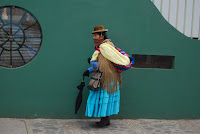
We departed from Cusco to arrive in Puno, the Peruvian frontier city whose borders, mountains and curves coexist in an embrace with the glittering blue sky waters of Lake Titicaca. We were somewhat sad on the way because we knew that we have reached the last city in Peru before we were to cross to Bolivia, and Peru has given us such rich experiences (including the ceviche, which we were determined to indulge in one more time before leaving Peru!). We were grateful for the Herstories we were able to document throughout our journey in this vast country. In Puno, we were looking forward to continuing making new connections and to expand the MUCOV Proyect. As our bus curved its long metal body down the road towards Puno, the sight of Titicaca´s diamond like reflection greeted us like an oasis in the desert greets a thirsty womyn after a long and strenuous journey. Puno is a small city with a big heart; its streets consist of long narrow sidewalks criss-crossing a few central streets and plazas in a maze like pattern. Despite its small size, it is an impressive city full of artists, restaurants with a lunch menu of big fried trout, treats and goodies of all kinds (including our favorite new flavor of ice-cream, Lucuma, originally a yellow-orange colored fruit with a unique flavor), noisy traffic and womyn selling bread, eggs, fruits, vegetables and traditional alpaca sweaters.
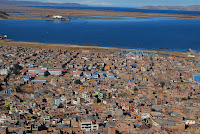
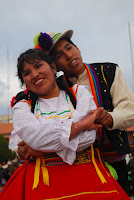
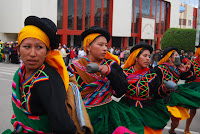
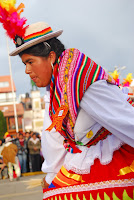
It seems that every day was a cause for celebration in Puno; it is not in vain that this city is known as the center of the folkloric culture and dance of Peru. About three times a week you could walk through its streets and hear the sounds of festive bands walking behind a colorful diversity of dancers in their traditional clothes for this or that dance of the highlands or lowlands or the Amazon or sierras or the coast of Peru. For us, it was a perfect opportunity to document the people of Peru at their most celebratory and festive mode: smiling, dancing, listening and wearing an overall sense of pride in the richness of their traditions. We visited some of the surrounding islands and got to learn a bit more about Lake Titicaca’s long history and its troubled present. The diversity of womyn in Peru’s border with Bolivia includes island womyn who often come with their families or on their own to work on the mainland of Puno and then go back to one of the islands spread throughout Lake Titicaca.
Our experience in Puno was short but very informative. It was in Puno where MUCOV had the pleasure of getting to know many incredible womyn and two of them who wanted to participate in the proyect. Needless to say that our encounter was achieved through the usual combination of randomness and luck.
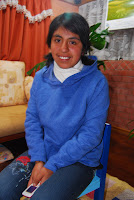
Patty Supo: A cheerful womyn with a great generous spirit and capacity to love and help the world that people tend to tell her that she is an overly trusting person. With a sincere smile and a tender reflection in her eyes she told us of her life and recounted the constant responsibility and care she feels for her younger sisters. Paty, who from a young age decided to go out and get to know the world outside of her birth town, ended up finding a home in Puno. She currently owns a little art shop and sells a variety of jewelry and fabrics that she herself crotchets. Always willing to reach out a helping hand to whomever is in need of one; Patty opened the doors of her life to us and shared her feelings and perspectives with us. Crislee Lopez: From an early age, Crislee has been a very active girl with a great gift expressed through her evident high intelligence. In the midst of the personal, social and global challenges this young womyn finds herself experiencing in her daily life, is a great infusion of perseverance, conviction and strength that cannot be broken neither by the doubts the world puts along her way nor by the harshest of her critics.
At her 15 years of age she has already worked in the radio, on television, and has initiated a campaign to promote the conservation of Lake Titicaca and our environment. Crislee told us of the acute situation Lake Titicaca has become a victim to. Extending at 3,800 meters above sea level, this vast lake is home to a diverse number of island communities and various species of birds and fish, many of which are in the process of extinction. With sadness, Crislee said that the lake will most likely not exist for our future generations to grow with, take care of and admire. She told us of the contamination the lake has been suffering in the form of trash, human waste due to the common causes of contamination and pollution: people take for granted what they have and the lack of information and resources perpetrates the cycle of violence against our planet. With a bit of rage mixed with indignation Crislee explained how traditionally many communities burn the hay known as ¨Totora¨, but that today it is practiced without a purpose and that burning this plant highly affects the native flora and fauna. Crislee explained that, “People cannot bathe along the lake’s coasts any longer because it is dirty. And the accumulation of sediments of contamination found in the bottom of the sea prevents the sun from reaching the species of plants and fish down there, inhibiting a full process of photosynthesis. This has very bad consequences.¨ Crislee described to us the hardships she has encountered in fighting to preserve the environment because this fight does not interest neither adolescents nor adults: ¨People have no interest and we have to figure out different ways in which to call their attention. Between sports, English classes, the radio, school, and hobbies such as chess competitions and mathematics, Crislee does not prioritize one activity over the other given that she manages do fit-it-all into one day! ¨It has become easy for me because I feel as if I have many worlds inside my world and I always need to notice what environment I am in and from there place myself in a certain context. Many people my age don’t think like me, and so I look for strategies in order to be able to think like them and in this way not go against the current or the world.¨ P.S – About the title (and Titles) For all we know young single womyn have been called Miss (or Señorita in Spanish) for ages. We noticed once we entered Peru that people, more often men, would refer to us as Miss Mayra or Miss Carolina or Miss Malinche. This caught us by surprise as we were not used to such formalities and more so, we felt confused as to how they knew were Señoritas still? This new addition to our name had brought about many thoughts in us: How can anyone tell whether we are married or not? And why is it even important to refer to a womyn as Miss? Or Mrs. (Señora)? And why isn’t there Mrs. version to Mr. I am now married? Whereas a womyn is marked by her age and marital status? We started questioning whether there were any advantages that came with these titles; in truth, we could not find any. But Malinche did have her own reflection on the subject: ¨Why does society have to mark my name and superimpose it onto a time and a space that is constructed as a result of the differences between men and womyn, womyn and womyn, and that difference transcends with age?¨ And this was the beginning of the…
The Miss Señorita Rampage
“What? What was that Malinche?” was the only thing we managed to say when Malinche decided to continue her tirade: “What I am trying to say is that my name is just Malinche. If I am young and single my name continues to be Malinche, if I do not get married my name is still Malinche, if I marry and then divorce I still continue to be Malinche and if I reach my 40´s or 50´s I am still, again, Malinche! Who invented the whole process of naming the stages of our lives and the aging of our bodies based on titles? We go form baby, to girl to Miss and if you marry a man you go straight to the Mrs. which is the worse one because womyn invisibilize their own last name and are branded with that of their husband’s. What purpose does this have in our 21st century? As for me, I say just call me Malinche and save the trouble of those unnecessary patriarchic formalities of measuring my body according to my age within the frame of my civil state and my wrinkles.” And she continued on for another 40 minutes explaining her stance…

Friday, September 18, 2009

CUSCO: The Navel of the World (tambien en Español)

Cusco: The Past and the Present outline this beautiful city

Cusco, the city known as “the navel of the world” during the times when the Inca Empire controlled most of South America, is unquestionably a beautiful city. It is charctarized by a facinating combination of ancient Inca architecture with the influence and abruptness of modernity. You can see the evidence of the conquest in all of its angles: two worlds colliding into one unique colorful and aesthetically pleasing city of smooth stones, narrow streets and with homes with pathways and wooden doors.

The churches, located in every eight block or so (and we are not exaggerating) maintain alive the memory of the spanish conquest, given that the immense foundations that support its elaborate murals and glass art is constructed of stones from the Incaic times; and the streets surrounding these churches are composed of narrow sidewalks whose width is measured at no more than half a meter. Cusco´s city streets are decorated with European style balconies hanging abouve wooden doors whose beauty and solidity does not diminish in the face of strong winds and pouring rain. While walking through the city streets one is struck by the over encompassing sensation of being transported into the distant past. The juxstposition of what once was and what will soon come to pass has been etched permanently into the the life and heart of this spirited town; a town that has burnt into its memory a blood-filled past yet continues to believe in a power superior to them, a power that unlike the lives of mere mortals, will never cease to exist.

The bright flag with seven different colors is proudly displayed all over the city and its statures, high above rooftops that assimilate the color of wet earth, on busy market corners, and in many of the local hostels.

“Is this the flag of the LGBT community?” asked one of the many thousands of turists walking through Cusco´s narrow cuty streets.

“Think again! This flag became Cusco´s official flag in 1978; plus, it is utilized by the original Andean communities of this region,” answered Malinche with her sultry know-it-all tone.

“But yes, in fact, the rainbow flag was also introduced in California during the 1970´s by the artist Gilber Baker as a symol of gay and lesbian pride. But there is a significant difference betwwen what it means to be a native of the Andean culture and what it means to express pride over sexual diversity. But without a doubt, co-existence is an inevitable when we are dealing with the complex subjects of identity and the struggle for rights and representation,” says Malinche, as she looks towards the sky but is interrupted by the big bright red hat she habitually wears.

“What would happen if there is a big march in which Andean folks, in particular Cusqueñas/os and the LGBT community unite to protest and march for their rights simultaneously?,” asks Malinche with a tone that seemed like she was really just thinking out loud.

“We dont know Malinche,” we responded, “But if that were to occur, there would be a parading sense of Pride in its most visible and powerful form that is for sure!,” we responded, hardly able to contain our laughter.

Cusco became our comfortable little nest for more or less two weekss (not counting our forray into Macupicchu). We allowed this city to bewitch us with its its soothing tranquility that was not defeated by the constant hustle and bustle movements along its maze like streets and invisible mortar. From the early hours of the morning untill the clock strucks midnight, the great numbers of residents and visitors never seem to stop and rest, while the local stores, restaurants, and bussinesses seem to follow the same schedule. We were fortunate enough to enjoy the company of wonderful “patas” (the local word for friends/sisters/homies) whom we met throughout our pleasent stay in Cusco. We took thousands of pictures of the city streets, faces, corners, of this and that womyn, ones we saw who never saw us, and of the ones who gifted us with unforgettable moments.

And here is our usual run-on paragraph of Cusco, which needs to be read only after you have inhaled deeply, and prepare to exhale slowly as you allow your eyes and these words to accompany your imagination through this journey:

City small volkswagon buses overflowing with 18 people stuffed in like sardines; the Market of Wanchaq and its vibrant colors; plagirized movies; the Molino as the local black market; Eating 1 kilo of fresh figs a day; Ivonne´s apartment as our little nest, Stood out 3 times in one day (YES 3 times!); Phone calls form the local phone-box parlors; Hours upon hours of internet resulting in headaches; Ceviche made of Pejerrey fish (a Peruvian delicacy); An actual bathtub (thank you Paty!); Womyn selling sweet potatoes on Garcilaso Avenue; Interviews; real spicy rocoto (the peruvian famous chile peppers); Antu cooking while the parokeet screams in the background; Chico, the street smart dog running behind Patty´s VW; Two portion Lukuma icecream; Dancing till sunrise; Working 13 hours straight; Taking more pictures; Preparing Mexican food; walking for miles; Alpaca scarves; Womyn selling tamales for 60 centimos (20 cents); The main square plaza filled with womyn selling scarves and dolls; Full moon; a visit to a rural school in Coya with Ligia; and a-lot-of conversations-smiles-and-laughing out loud-in-a-lunch-dinner-gathering-of-six-strong-beautiful-femenist-who-do-not-fear-in-the-power-of-dreaming!

AND These are some of the womyn MUCOV met in Cusco:

As you allready know, our work and dedication to MUCOV never ceases to bring us to some unforgettable conversations with womyn who have plenty to share about themselves and their lives. Here is a short summary of these necessary and inspiring dialouges, ones that help teach us about the vast reality and the experiences of other sisters.

Julia Beatriz Paliza: A strong, independent and successful womyn with a past that has taught her

to keep ahead, keep fighting as a single mother who started her own tourist agency; a survivor who did not give up in face of either loneliness or depression. Between laughter and tears, Julia told us of her difficult past, in which all of her family was dispossed of their home and land property after the Peruvian agrarian reform in the 60´s; she recounted her experiences of living in the Peruvian jungle with her then police officer husband in red zone (considered dangerous becasue of armed conflict) and her being a witness to multiple injustices, police abuse, corruption and human right violations against innocent people. She had to move to Cusco and start a new life from Zero, supporting her children alone by any means possible after seperating from her husband without having any help available from her family. Julia continued to share with us about her health problems, about her knee surgery and her refusal to use a walker becasue of her belief that the power to walk on her own haa always kept her strong and firm. Presently, Julia is looking to better her buisness and to wants to become a better mother for her children, who support her as much as they challenge her. And often, the only option left for Julia is to laugh out loud in the face of all the critical situation that she has to confront in her everyday as a womyn.

Francisca and Beatriz Huachaca: Francisca is a strong womyn, filled with sadness and pain. She has been challenged by life and a plethora of harsh circumstances. At the age of 46, she tells us of the constant care she keeps over her daughter Beatriz, who herself has experiencedmuch pain and suffering in her short 10 years of life. Recently, Francisca had to burry her 16 year old son, who died under unexpected circumstances; She shared with us her pain and sense of impotence in the face of this tragedy. Francisca had to forge ahead as a widow and a mother of 5 without any stable financial resources, without her own property or land to provide sustances and secturity for herself and her family in the rural region where she resides. Left without an official employment, Francisca tries to make a living by selling toasted beans on one of Cusco´s central sidewalks, accompanied by her daughter, the young Beatriz, who became paraplegic at the tender age of 6 as a result of medical negligence. Mother and daughter hope to gather enough funds to return to Combabat, their home town, and to buy the medicine necessary to help little Beatriz´s body heal. In addition, Francisca expressed that she cannot return unless she has enough money to pay for her son´s coffin as she is currently in debt with the architect. Her green shawl wrapped tightly around her, her eyes the color of brown earth, Francisca rises to leave, adding that she has to keep looking ahead, that her life is diffcult and challenging but that the only option she has is to keep fighting.

Ivonne Maribel Acurio: Hard working and fighting for what she believes in, Ivonne describes herself as an enterprising and jovial womyn. As if by magic, Ivonne, finds enough time to have clients in her office as she is a practicing psychologist, to teach Spanish courses in an institute, and to be a mother and wife with all the demands that the domestic realm produces. She is also the director of a health magazine which gets published on a monthly basis. She shared with us her experiences of being a student at the University, of her past, her family, her journeys, her professional aspirations and the beautiful memories of her childhood plays in Cusco. With a contagious smile, Ivonne opened the doors of her past in order to tell us what she has constructed and dreamed for her present.

We are en route to the frontier city of Puno in which the famous Lake Titicaca seperates Peru from Bolivia. FYI it is the biggest lake in South America and the highest navigable lake in the world at 3,800 meters above sea level.

P.S: Vocabulary: Trome (great, cool, awesome) is another word to add to our vocabulary!

P.S.S: Gift: Malinche bought some of Cusco´s colorful raimbow flags and said she would send one to anyone who tells her that they had a vasectomy!

AND VISIT OUR NEW ALBUMS OF CUSCO:
Click Here: Womyn in Cusco:

Wednesday, September 16, 2009

CUSCO: El Ombligo del Mundo (ESPAÑOL)

Cusco: El pasado y el presente dibujan esta hermosa ciudad

Cusco, la ciudad conocida como "el hombligo del mundo" durante el imperio Inca es una ciudad indudablemente hermosa. Tiene como characteristica propia una combinación desequilibrada de los tiempos incaicos con la actual arquitectura que introduce abruptamente la modernidad, pero que sin embargo le da vida a una estética única.

Las iglesias ubicadas ha cada ocho cuadras (no estamos exagerando) mantienen viva la memoria de la colonización dado que la base que sostiene sus muros y vitral esta compuesta de piedras incaicas y las calles que las rodean son angostas con andenes de no mas de medio metro de anchura. Las calles tienen balcones estilo europeos que le dan sombre a las puertas de madera que no se rinden frente a la batalla del viento y lluvia. Caminar por estas calles de piedra es como dejar que todos tus sentidos viajen por el tiempo. La yuxtaposición de lo que fue y lo que será se ha quedado plasmada permanentemente entre todo lo que conforma el entorno de esta pequeña ciudad que guarda un pasado de conquistas sangrientas pero que mantiene una fe por algo superior que no cesa de existir.

La bandera de los siete colores se muestra sobre los techos de color tierra mojada, sobre las alturas de la ciudad, en las equinas de mercados y en varios hostales.

“¿Es la bandera de la comunidad LGBT&I?,” pregunto unos de los cienes de turistas que se pasean por las calles Cuzqueñas.

“Que va! Esta es la bandera que se hizo oficial en Cusco desde 1978 y es la bandera que también utilizan comunidades originarias Andinas,” contesto Malinche con su tono de sabe-lo-todo.

“Pero bueno, en California también se introdujo la bandera de colores en la época de los 70´s como símbolo del orgullo de la libertad gay y lesbica por el artista Gilber Baker, pero hay una gran diferencia entre lo que es ser originaria/o de los Andes y expresar el orgullo sobre la diversidad sexual; sin embargo la co-existencia es algo inevitable cuando se habla de identidad y lucha,” dice Malinche con la mirada hacia el cielo pero bloqueada por el gran sombrero rojo que habitualmente lleva puesto.

“¿Que pasaría si se uniera una manifestación de personas Andinas, en particular Cusqueñas/os, con una de las marchas por la diversidad sexual?” pregunto en voz alta.

“No lo sabemos Malinche, pero eso si, hubiera orgullo fuerte y visible por toda parte!,” le contestamos sin poder contener la risa.
Cusco fue nuestro nido por más o menos veinte días (sin contar nuestro paseo a Machu Picchu) mientras nos dejábamos embrujar por la tranquilidad que tiene esta ciudad a pesar del movimiento constante entre sus antiguos laberintos de piedra pulida. Desde las 6am hasta la media noche los visitantes y residentes parecen no descansar y los locales, restaurantes, y pequeños puestos estan abiertos. Siempre estuvimos disfrutando de la compañía de buenas patas (amigas/manas/parceras) que conocimos durante nuestra estadía. Tomamos miles de fotografías de la cuidad, de los rostros, de las esquinas, de ellas, de aquella, de una, de otra, de la que miramos, de la que nunca nos vio y de las que nos regalaron momentos inolvidables.
Y aquí nuestro resumen de Cusco que se lee siempre y cuando primero hayas respirado profundo, y antes de empezar a lentamente exhalar, deja que tus ojos nos acompañen guiados por estas palabras y tu imaginación:
Colectivos con 18 personas metidas como sardinas, el mercado de Wanchaq y sus colores brillantes, películas pirateadas, el Molino como el mercado negro, comer 1 kilo de higos por día, Ivonne y su apartamento como nuestro nido, plantadas TRES veces en un día, si Tres veces, llamadas desde locutorios, Internet por horas, Ceviche de pejerrey, baño en una tina (gracias Paty), Avenida Garcilaso con vendedoras de camotes, entrevistas, rocoto bien picante, Antu cocinando mientras el perico grita, Chico el perro callejero correteando el VW de Paty, helado de Lúcuma de dos porciones, amanecer rumbeando, trabajar 13 horas seguidas, mas fotos, preparar comida mexicana, caminar, chalinas, mujeres vendiendo tamales a 60 céntimos, la plaza de armas con vendedoras de muñecas y chalinas, luna llena, visita a una escuela rural en Coya con Ligia, y un-monton-de-sonrisas-y-carcajadas-en-un-almuerzo-cena-compuesto-por-seis-mujeres-femenistas-fuertes-hermosas-y soñadoras!

Y estas son unas de las Mujeres que conocimos con MUCOV en Cusco!

Como saben nuestro trabajo y compromiso con MUCOV siempre nos llevan a conversaciones inolvidables con mujeres que tienen mucho que compartir. Y aquí esta un corto resumen de esos diálogos necesarios que inspiran y que también nos enseñan un poco sobre la gran realidad de las experiencias de otras manas:
Julia Beatriz Paliza: Una mujer fuerte, independiente, triunfadora con un pasado que le ha enseñado a seguir adelante como una persistente madre soltera que empezó su propia agencia turística y que no se dejo atrapar por la depresión ni la soledad. Entre lagrimas y risas, Julia nos contó sobre su pasado cuando toda su familia fue despojada de su hacienda después de la reforma agraria en los 60´s, de cuando vivió en la Selva Peruana con su entonces esposo en zona roja y como ella fue testigo de muchas injusticias, corrupción y abuso policial, atropellos y violaciones en contra de personas inocentes; de cómo tuvo que empezar otra vida después de haberse separado del padre de sus hijos sin el apoyo de su familia. Julia quien hace muchos años llego a Cusco, tuvo que empezar de zero y trabajar en varias chambas. También nos contó de sus problemas de salud, de su cirugía en la rodilla y de que ella se rehúsa a usar bastón porque siente que la fuerza para caminar sola siempre la ha tenido firme. Ahora continúa buscando como mejorar su negocio y como ser mejor madre para sus dos hijos quienes la apoyan pero igualmente la retan y muchas veces solo se puede reír en voz alta de todas las situaciones críticas que tiene que enfrentar como Mujer.
Francisca y Beatriz Huachaca: Francisca, una mujer fuerte, triste, y retada por la vida en un sinnúmero de formas. A sus 46 años de edad ella nos cuenta sobre el permanente cuidado que tiene sobre su hija Beatriz quien tiene tan solo una decada de vida. Francisca recientemente tuvo que enterrar a su hijo de 16 años ante una muerte inesperada, y nos hablo sobre su dolor y sobre su sentido de impotencia en estos momentos. Ella ha tenido que salir adelante como mujer viuda, como madre de 5 hijos sin tener recursos ni ayuda financiera estable, sin tener terreno propio ni chacras en la zona rural de donde ella proviene. Sin empleo oficial, ella vende habas tostadas en las calles de Cusco, sentada en el andén junto a Beatriz quien quedo parapléjica después de sufrir negligencia medica a los 6 años de edad. Esperan recaudar lo suficiente para regresarse a Combabata y poder comprar los medicamentos que necesita la pequeña Beatriz. Además, Francisca nos cuenta que no puede regresar sin no antes tener la plata para pagarle al señor quien les vendió el cajón para enterrar a su hijo. Con su chompa verde, sus ojos llorosos, ella se levanta y dice que tiene que seguir adelante, que su vida es dura pero tiene que luchar porque no hay de otra.
Ivonne Maribel Acurio: Una luchadora, trabajadora, y mujer que se considera emprendedora y jovial. Ivonne encuentra como magia el tiempo suficiente para tener su consultorio como psicóloga, para ser profesora de español en una institución, para ser directora de una revista de salud, para ser madre y para sostener a un hogar con su familia en su casa/consultorio/oficina! Ivonne compartió sus experiencias como estudiante en la universidad, sobre su familia, sus viajes, sus logros como profesional, y sobre sus bellos recuerdos de las travesuras que acompañaron su infancia en Cusco. Con una sonrisa contagiosa, Ivonne abrió las puertas de su pasado para contarnos lo que ella ha construido para su presente.
Seguimos rumbo a Puno en donde se encuentra el Lago Titicaca dividido entre la frontera Peruana y Boliviana. PQS (para que sepan) es el Lago mas grande de Sudamérica y uno de los lagos más altos del mundo a 3,800 metros de altura!
Pd: Vocabulario: Trome (súper/bacano/chido) es otra palabra que se va agregar a nuestro vocabulario! Pd: Regalo: Malinche se compro una bandera cuzqueña para enviársela a todos los que le cuenten que se hicieron una vasectomía!
PARA VER FOTOS DE CUSCO VISITA NUESTROS ALBUMES:
Cusco la cuidad (en Blanco y Negro):

Machu Picchu and we still Wonder

The Bicycle Diaries : MUCOV on the Road! Once we settled in Cusco for a bit, we started searching for the best and most affordable way to make our path to one of the seven marvels of the world (and to make Carly´s long time dream come true): the ancient and mysterious world renown site of Machu Picchu. We picked Julia Tours, a family owned tour agency managed by upbeat Julia, a womyn with a fascinating Herstory who we later interviewed for the MUCOV Proyect. We decided to take one of the roads a bit less traveled: a four day route of which the first day includes a four hour bike ride and the rest consists of a trekking journey all the way to Machupicchu. With anticipation and excitement, we were off to the nearby town of Ollantaytambo known as the last Inca city of Peru. Curved into the mountain side above its city streets are impressive agricultural terraces left from the royal estate of the Inca Emperor Pachacuti. We marveled at the way in which the small town, crisscrossed by the remaining long water ducts, had managed to preserve its ancestors´ presence in the streets and in the air surrounding its mountains.
From there we went up a long winding mountain path. We had plenty of time to get to know our guide Marco, a young and cheerful man, knowledgeable on every Inca aspect. Due to change of plans of other travels, Marco became our own personal guide for the whole four days of the trip! Lucky us. We also got to know Julia and her young son Jack and our driver Carlos and passed the rest of the ride exchanging jokes, stories and laughter.
As we were reaching the top our stomachs begin to tighten and we were warned, ¨not to get nervous or look down." We were about to descend a mountain highway, full of passing cars and trucks, of winding curves and only our wits and our warm scarves about us! The van with Julia would be trailing behind us, filming us as we rode and watching over our wheels and all of our body parts. But what a thrill!
With the wind whistling free!
A rhythm our feet follow in circular glee
Sky above and below
The colors blend in slow
Mountains move as we pass
Majestic blurs in our path
The curves of our bodies match those of the earth
Divided into parts that together give us birth
Hearts, wheels, brakes, ears,
Speed,light, hands, steer
Bicycles or bodies?
There or here?
Moving along or standing still?
Peddeling fast that is for REAL!
In one of frequent picture-and-filming stops Marco mentions, "You ladies are doing something like the Bicycle Diaries!" We thought it was actually really funny and responded stating that we would title our adventure as such. At the end of the day we fell like monolithic stones onto our hostel beds in Santa Maria. Our next two days passed by in a walking blur. Here is the MUCOV usual run-on adventure description:
Ruins, dirt roads, hot springs, Santa Teresa, full meals, heat, the past, womyn construction workers, rainbow, gushing waterfalls, lots and lots of evil blood-sucking mosquitoes, Mayra with a full blown allergy reaction (only appearing sexy to more and more mosquitoes), Monkeys, Inca trails, Chasquis (agile and highly-trained runners that delivered messages and other objects throughout the Inca Empire), trains, bridges, coca tea, llamas, alpacas, mountains, climbs, steps, rivers, hydraulic plant, never ending train tracks, the tourist packed city of Aguas Calientes, plants and flowers beautiful and unfamiliar to us, wind, dirt, hammocks, new friends, clouds, cold , anticipation, 3:30am hike, sunburn, Malinche falling, and lots of pictures! On the fourth day we woke up at 3 in the morning so that we could start the one and a a half hour climb up steep stone steps to Machupicchu. We wanted to arrive early in order to purchase the limited entrance ticket to climb the near by mountain of Wayna Picchu. In the cold and dark we waited by the gates as more and more tourists started pouring in. We were to meet with a guide who would show us around for two hours and then we would be left to explore the site on our own. What would we find as we walked in? Is it as magnificent as the stories tell it to be? We were about to find out.
First thing to greet our vision
Magnificent green giants surrounding a sacred site
Abandoned for a reason unknown by us
Sleeping for centuries and then woken up

Overtaken by ambitious and greedy industries of wealth Waiting for the masses that pass its gates All the feet that trespass its sacred grounds All the hands that touch its smooth long lines

All that was forgotten and can never be brought back

Immense smooth rocks, fused together like the moon and tide By unknown creative hands and tools Following visions of universal magnitudes Ingenious minds with knowledge of the greater stars

Rich cultures of suns and gods and rituals of light An empire of vast understandings And only a glimpse into its past A kingdom of temples constructed with gold
Once upon a time too significant to behold

Stretching halfway to the horizon A mysterious city of stones carved with might The echo of warriors protecting its fronts A king with power weaved into his tresses
The sound of his commands bound with the fate of the sun reaching across all of the borders together made into one

Long rows of green mixed with gray Traces of the working voices dreaming the land Whispering to the Pachamama their knowledge of the bigger plan Their hands filled with seeds Their bags overflowing with water Manifesting the same destiny shared by their mothers and daughters

We are left with the silence of spirits past Their presence felt in the smooth rocks and green paths The sounds of rituals, work and songs carried by the winds Are covered by the curious footsteps Of hundreds and thousands of stranger dreams A purposeful past forever unknown to us A present in which we have to maintain what we have and keep looking back.

Monday, August 31, 2009

AND NOW WE ARE THREE!!! (Abajo en Español)

What? Another womyn joins MUCOV in their travels?
Who is the new womyn who has recently joined our team? She is a young womyn who calls herself Malinche. We met her on the bus during our trip from Lima to Arequipa, Peru’s second largest city. That Saturday night we were feeling a bit hyperactive due to the fact that we had one too many cups of Yerba Mate and the thought of sitting down for 9 hours was already causing us anxiety. After the first two hours of the journey at night, we were frustrated due to the frequent stops we being forced to deal with. We thought that we would never arrive to our destination, given that every 45 minutes the driver stopped to collect, in a very informal but traditional manner, people from distant villages on their way to the cities. In this way, the driver and his assistants manage to earn a few extra soles (national currency), and those people living far from the central terminals also manage to board the bus midway on its journey.
In the middle of this chaos, a womyn of small stature wearing a deep red colored dress walks into the bus. Seeing the intensity of her attire’s color it was hard not to think about the scene that repeated itself too many times in the past: blood splayed out over the rocks marking the paths our ancestors constructed with their great knowledge of architecture and physics. Her two long braids, reaching down beyond her waist were a beautiful sight to behold. The mystery womyn, followed by her silky black pearl extensions, entered the bus and walked down its isle towards the center. There she stopped, and with s few graceful movements arranged her instrument and spread her legs to position herself with a perfect balance. Once she was ready, she placed her right hand over the strings of her most precious treasure: her guitar. With the same passion with which a singer performs on her best concert to thousands of hypnotized audiences, the womyn began to sing:
“Yo soy, yo soy, yo soy Soy agua, playa, cielo, casa blanca. Soy mar atlántico, viento de América, Soy un montón de cosas santas Mezcladas con cosas humanas. Como te explico cosas mundanas Fui niño, cuna, teta, techo, manta Más miedo, cuco, grito, llanto, raza, Después mezclaron las palabras O se escapaban las miradas...¨
It was the same song we heard a few months ago by Mercedes Sosa when we had just left Colombia one gloomy afternoon while sitting in a café in the border city of Ipiales, Ecuador. The voice of the mystery womyn was so beautiful and captivating that whoever did not keep their silence would have been offending the very same virgin that the agnostics continue to keep in the shadows. Silence transformed into a coir of angels materializing themselves through her undeniably smooth and mesmerizing voice, coming out of her belly button to be released through the window of her lips. Her melody was so in tune that not even the continuously abrupt jumps of the bus could disrupt the harmony of her voice. Two more songs accompanied the audience in their silence (Lucy in the Sky with Diamonds by the Beatles and Besame Mucho by Pancho Céspedes). When she finished singing, we got out of our trance as well, and noticed, somewhat in awe, that we were still on the bus.
The womyn began to collect the coins that her improvised audience offered her, passing through each row of seats until she reached us. We immediately asked her: “What is your name?” “MALINCHE,” she answered, with such firmness in her voice that it seemed as though the mere sound of her name marked the fine line of her lips. Right then and there we told her everything about MUCOV and that we would love to hear more about her life, about Herstory. “Of course sisters! I am an Americana (meaning from the western hemisphere) without borders and so are you! Not only that, I think that there is so much to learn about each other and I want to support you! I will fundraise for you with my music! I do not have a fixed nest on any tree in this world which makes me a sorta nomad so let’s go! But, where exactly are we headed to?”
“To Arequipa,” we responded, “and we will continue on our path through South America until we get to Uruguay.”
And that was the Saturday night; actually it was more like Sunday morning that our path crossed with that of Malinche’s ,or hers with ours? Or is it just one path?. “And does your name originate from the Malinche of Cortez’s era in Aztec land, or the volcano in Puebla, or the tree known as Delonix regia?” we asked.
“My name refers to me, to all of the past that has brought me to this present many moons ago. I can be gentle,misunderstood, strong, mother, volcanic, a tree with red flowers; and I can also be what I whole heartedly wish to be, whenever I want to, without limits or restrictions, and without having to explain the how and the why,” said Malinche.
“Understood”, was all that came out of our mouths, and that was the moment we realized that Malinche was going to show us, little by little, the world which lead her to the same bus that we were sitting in.
The voice of this young womyn reached our souls and it will continue to accompany us throughout our travels. “I want to visit all of the countries in which womyn govern in the Americas. The good thing is that it will be low cost for me because I am only missing Argentina. I have already visited Sra. Bachelet when she was first elected.”
“All right Malinche, but don’t let your trip end there. Imagine how many more womyn leaders there are that reside in hundreds of diverse contexts that are not recognized on a national level but that are nonetheless fighting for a better world from their own surroundings; it will be great to create connections and initiate encounters between all of us,” we said.
“Of course they exist, my human poppy seed, or better stated my heroines; like the empanada vendors in the street corners, like the womyn who get out of jail to keep fighting, like the womyn who sell their fruits and vegetables in the central markets sitting like goddesses amongst the garden of vivid colors, like the womyn selling Palo Santo (holy wood) for the passerby in need of a blessing, almost invisible alongside the towering churches and cathedrals they stand next to. My heroines are also those womyn who never learned how to read and write yet with their voice they gift us with poems, verses and their sweetest melodies come out of their hearts and through their bodies until they slide smoothly from their womb and out to the world.”
“Exactly. There are many heroines who fight everyday to overcome the difficulties they are born into, to move forward; womyn who refuse to give up, who do not tire of walking firmly on their path,” we reckoned.
When we got to Arequipa around 6:00 in the morning, we addressed ourselves in unison to Malinche: “Welcome to MUCOV Malinche! But where are your things? Don’t you have a bag?” we asked.
“Not at all! I only carry my Confession (referring to her guitar). Besides, I don’t need anything else, since this brain of mine weighs way too much already!”she respondes almost offended by our question.
“Great! Then you can help us with our bags, since those vainas weigh more than we do!” we responded.
"Malinche, now that I remember, the Malinche of the land of the Mexicas was also known as Malinalli Tenépal, and back when I was taking a class at Los Angeles City College (LACC), my professor Kalinde told me that the word Tenépal in Náhuatl means: a person who possesses an easy manner with words, who talks much and animatedly,” commented Mayra.
“Well, what a coincidence,” responded Malinche, with a mischievous half smile on her face.
P.S. ¨Open Veins of Latin-America¨ by Eduardo Galeano: Malinche says that she will use the money she collected on the bus to send Hillary Clinton a copy of Mr.Galeano´s book since she doesn´t think Obama should be the only one expected to read it.